Caterina De' Medici is typically associated with a strong and to-be-feared persona. And yet, for much of her life, she was adrift and powerless. In that process she must have learnt quickly! Aged just 14 she was married to the second son of the King of France. As luck would have it, her husband succeeded to the throne as Henri II, but again as luck would have it, he and his mistress, Diane de Poitiers, marginalized her completely. Henri II died before his weak son Francis II had attained majority, and Caterina, by some deft costume changes - always dressed in black - created a more assertive character for herself and assumed the role of Regent. Her first two sons died young - but she did have three, and her third son Henri III survived her, taking her advice throughout his reign.
It is from here that a stitch very much resembling, and sometimes mistaken for, double-running stitch is named. Like double-running stitch, this stitch presents a clean design on the front and the reverse of the fabric - usually burato - which allows it be used for decorative edges to cuffs and collars, as well as for decorative household items such as napkins and other cloths. Below, in the video you can see how it is worked. Click here to see the instruction books for Punto Madama.
Friday, 17 August 2012
Thursday, 16 August 2012
The Stitching Museum Eibenstock Germany
Situated in Eibenstock, Germany close to the Czech Republic border is the Stickerei Museum which displays some very interesting stitching tools as well as stitched items. I was particularly interested by this multi-sewing machine set up driven by a jacquard paper tape unwinding from a spool (seen top right of picture) to create self-driven, multiple, identical embroideries. For more details of this museum, click here.
Wednesday, 15 August 2012
Samplers from Robert Hirschhorn
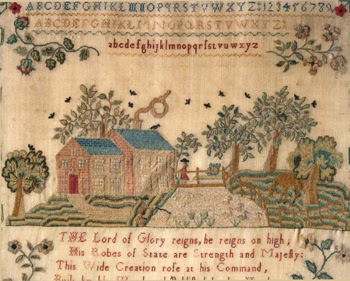
About 15 minutes drive from Sloane Square in central London you will find Robert Hirschhorn Antiques with some delicious samplers for sale - in addition to lovely antiques.
Here are some examples for you to enjoy. If you are planning a visit, simply phone ahead for an appointment.
Click here to see more and for contact details.
Tuesday, 14 August 2012
The Ragged School Museum London
If you are in London, don't miss out on a visit to the Ragged School Museum in Bow, London. When Thomas Barnardo came to London from his home city of Dublin in 1866, intending to train as a doctor and then become a missionary in China, he was confronted by a city where disease was rife, poverty and overcrowding endemic and educational opportunities for the poor were non-existent. He watched helplessly as a cholera epidemic swept through the East End, leaving over 3,000 Londoners dead and many destitute. He gave up his medical training to pursue his local missionary works and in 1867 opened his first "ragged school" where children could gain a free basic education.
The school was housed in three large canal side buildings and here there are several gallery areas which include a reconstructed Victorian Classroom and a Victorian East End Kitchen displaying its own collection of historical artefacts, all designed for hands-on inspection. This is a museum where you can sit at the school desks, use the tin bath(!) and experience what life was like for the Victorian poor of the East End of London. For opening times and more details, click here.
The Ragged School Museum
Subscribe to:
Posts (Atom)


.jpg)