Stomachers were the decorative centre panels of dresses worn in the 17th and 18th centuries. They could be used to cover up necessary bodice fastenings; to update a tired dress; to make it special for a certain occasion; to conceal a busk; and to save a dress when unaoidable eating accidents happened! Sometimes as in the last example they still have the tabs on either side for pinning or stitching onto the main bodice of the dress.
These lovely stomachers are in the Musée Des Arts Décoratifs, Paris. To see more embroidered items in the collection click here.
Saturday, 4 June 2011
Friday, 3 June 2011
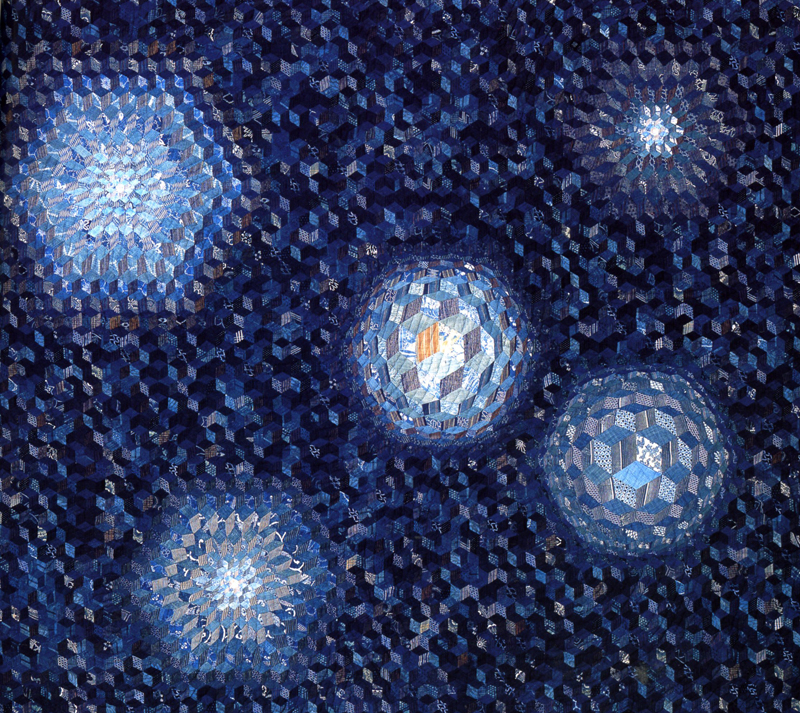
Those Cosmic Blues by Kuroha Shizuko
Probably one of the most affective patchwork artists today, Kuroha Shizuko's quilts reach those depths of soul others have yet to fathom. Working with old indigo dyed kimonos, using asymmetric variations of well-know quilt patterns, Kuroha-san achieves a divine marriage of dynamism and harmony. It is almost like flying.
This pattern with its interpenetrating and reverberating waves is aptly called Echo.
And here you can see a little more detail of how the blocks of Echo have been composed.
I love, too, the combination of blues and golds, and this creation is called The Sky Away From Home.
You can purchase the book - though with German text from Amazon. To see more click here.
When I was in Kyoto a few years ago, returning back to our hotel on the bus after the disappointment of having found the textile museum closed, I got off the bus too early and found myself in the middle of a vast market which filled a temple precinct - everything being sold there was old kimonos - fabulous. I could have bought as much as I liked - but how to choose from all that vastness of choice? And to have been intent on purchasing I would surely have missed seeing everything.... instead I just wandered around and let the beauty of it all wash through me. And today, I am glad because I can still go back to that place and beauty in its entirety in my mind. And for my quilting project? Well, no fabulous old kimonos, that is for sure - and would I ever have found the will to cut into them at all? Probably not. Instead here is a selective heap of my husband's old shirts I have been squirrelling away for decades - now those I can happily take a pair of scissors to!
This pattern with its interpenetrating and reverberating waves is aptly called Echo.
And here you can see a little more detail of how the blocks of Echo have been composed.
I love, too, the combination of blues and golds, and this creation is called The Sky Away From Home.
You can purchase the book - though with German text from Amazon. To see more click here.
When I was in Kyoto a few years ago, returning back to our hotel on the bus after the disappointment of having found the textile museum closed, I got off the bus too early and found myself in the middle of a vast market which filled a temple precinct - everything being sold there was old kimonos - fabulous. I could have bought as much as I liked - but how to choose from all that vastness of choice? And to have been intent on purchasing I would surely have missed seeing everything.... instead I just wandered around and let the beauty of it all wash through me. And today, I am glad because I can still go back to that place and beauty in its entirety in my mind. And for my quilting project? Well, no fabulous old kimonos, that is for sure - and would I ever have found the will to cut into them at all? Probably not. Instead here is a selective heap of my husband's old shirts I have been squirrelling away for decades - now those I can happily take a pair of scissors to!
Thursday, 2 June 2011
King Charles I - His Knitted Vest
As a knitted item in itself, we would appreciate this wonderfully designed and patterned vest. Believed to have been worn by King Charles I and bearing the very poignant blood-stained reminders of his execution, the vest stands as a very powerful and particular testament to its time, and our aesthetic appreciation of a simple artifact is transfromed into something deeper and more contemplative about life itself, about the very clothes that we ourselves are wearing, today...
This 17th century vest is now in the Museum of London.
Wednesday, 1 June 2011
Mary in the Rose Garden, 15th Century Tapestry in the St Marien Kirche, Rostock, Germany
And this is why this wonderful piece is called Mary in the Rose Garden - right in the middle of the tapestry, Mary cradles the Infant Jesus, watched over by four angels, in the midst of masses of roses. How this tapestry came to be in the St Marien Kirche and what purposed it served, no-one knows. It is conjectured that the piece was made in one of the Rostock monasteries or hospitals around 1450.
Here you can see the work in its entirety - it is very large, but I have yet to trace its exact measurements - perhaps a German reader can help us?
Surrounding Mary are scenes from the Old and New Testaments which prefigure later stitched embroideries and applied works. For example, Abraham's Sacrifice which you can see above. And below Jesus at the well with the woman of Samaria and beneath, Judith and Holofernes. So, all these tableaux were part of a well established repertoire of textiles before the Stuart embroideries of the mid 17th century.
Here you can see the work in its entirety - it is very large, but I have yet to trace its exact measurements - perhaps a German reader can help us?
Surrounding Mary are scenes from the Old and New Testaments which prefigure later stitched embroideries and applied works. For example, Abraham's Sacrifice which you can see above. And below Jesus at the well with the woman of Samaria and beneath, Judith and Holofernes. So, all these tableaux were part of a well established repertoire of textiles before the Stuart embroideries of the mid 17th century.
Subscribe to:
Posts (Atom)