Pages

Friday, 24 September 2010

Mary Jenkins' New Quilt Blog on the Block


I really love quilts and quilting and in one of my parallel lives I spend all day quilting......you know what I mean about parallel lives, I know, you told me how you would find the Needleprint Blog more interesting and useful if, as well as charts and jigsaws, we would also have free Time downloads! (I'm working on that.) Where was I? Yes, in a parallel life, quilting. So, you can imagine my delight when one of my favourite quilter-authors, Mary Jenkins, told me she now had a blog. I looked, loved and, and of course, couldn't wait to share with you. Just click here to Mary's delightful Little Welsh Quilts and Other Traditions blog.

Thursday, 23 September 2010

Save Over £200 - The Delights of Digital

I know the debate about digital versus a lovely, real, tactile, paper-book-in-your-hand continues. Just last week I was looking to see what was new in some of the little cutting-edge design stores in Brighton and found a table full of Selvedge magazines. For about the third time this year, I found myself gathering up armfuls of this wonderful, bi-monthly, dedicated-textile magazine ready to go to the till - even at nearly £10 a copy, I was ready to take the pain in my purse. But then the still, small voice that gets to me everytime I approach a cash till with magazines or books, asked yet again, And when you have read them, where will they go? Will you be able to remember where all the good, inspiring articles are in them - and quickly - or will you have to trawl through them all for that one special article? I have a studio full of books and magazines, partly indexed and cross-referenced, but frankly without taking on extra staff, I know this indexing is a battle waiting to be lost. And, back there in Brighton, I knew, deep in my heart, that if I wanted so many magazines, it really did make sense to wait and take out a subscription when I got home. And that is what I did. But joy of joy! I could take out a digital subscription for a reduced rate of £25 for 6 issues - and not only that, I had access to 23 back copies also! W-w-w-wow. Child in a sweetie shop, is what you would have thought if you'd seen me then. I can save pages as jpegs to special folders so I can find what inspired me again and quickly - no scissors, no wondering if I'm cutting up something important on the other side. I have to say, if you are curious about the delights of digital, there is no better way of finding out - at the end of the year I shall have enjoyed 29 Selvedge Magazines for just £25 - and that is more than an armful, by anyone's reckoning.

Wednesday, 22 September 2010

Manchester Art Gallery On-Line Sampler and Jacket Collection


For those of you who are not able to join the fabulous Jacket Tour of the UK, Manchester Art Gallery has some rather lovely examples you can enjoy looking at on-line - and some samplers for good measure, too. This spendid example is from 1661. It has the well known extract ending with Learning is most excellent and you can see from here the reversal of stitched s. It is thought to have been stitched by Mary Tradenham who later married the second baronet Filmer, which gives some idea of her status. There is also a whitework sampler in the collection stitched by Mary.

This superb jacket of 1610-1620 stitched on linen and edged with metallic Van Dyck lace is simply stunning with its scrolling vine design.
This black work jacket intrigues me - there is much here that recalls Persian Resht designs, not least the working of alternating designs on the diagonals. Dated 1600-1625 the period matches a great interest in Persian culture - the Persians were considered European allies against Turkish expansionism. I wonder....
Not strictly a jacket, but a rather beautiful bodice for domestic wear which I covet greatly, I just know I would look good and graceful in it. It is dated to between 1625 and 1640. If you would like to explore the Manchester Art Gallery Collections, just click here.

Tuesday, 21 September 2010

School Name Tapes, Stuke Bombers and Quakers


My school had a later start for the autumn term than others - and no matter that we enjoyed an extended two month summer holiday, it was always on the day before the new school year that I began the rather tedious (and rushed) job of stitching name tapes on my uniform, though the tapes had been in the workbox all summer. This is how I remember Cash name tapes. That and trawling through lost property baskets hunting for the misplaced gameshirt or sock - yes, each last and lost sock had to have its own name tape! There was a short time when we had a male teacher for music in school - just a term. One of his responsibilities was to play the piano for daily assembly when the whole school of girls and female teachers trooped into the hall. One day there was quite a pained sound coming from the piano and just as we had all arrived, he jumped up from his piano stool and in a fit of rage opened the top of the pianoand pulled out - girls' underwear. We didn't see much of him after that.....and we never knew to whom the underwear belonged as it had no name tapes. You would have thought someone would have missed them though, wouldn't you?


So what has that to do with Stuke bombers. Well, just one Stuke bomber pilot who we met one year while mountain climbing near Mittenwald. He was an old, ill man who we had heard coughing the whole night through where we were staying, and in the morning we could see he wasn't well at all. Though we always chatted with everyone at breakfast in a mixture of German and English, he never spoke a word to us - until the morning we were due to leave. Then he told us in broken breath that he had piloted a Stuke in that terrible raid which reduced the city of Coventry to rubble overnight in the war. He ended by saying he was 18 at the time and very frightened.
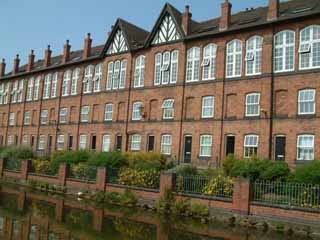
And Quakers? John and Joseph Cash, were born to a wealthy Quaker merchant in Coventry and joined the manufacture of silk ribbons for which the city was famous. Over 45% of the people, many descended from refugee Huguenots, earned their living in some form of ribbon making in the 1840s. The Cash brothers were enlightened manufacturers and had a system which allowed people to weave in their own homes while harnessing power and technology to speed their work - they built Topshops for people to live in the lower stories and weave in their lofts, where gears driven by local steam power ran through the whole terrace to drive the looms. By the 1860s the industry had crashed and many became paupers. However, the manufacturers worked hard to create other niches - they wove commemorative ribbons, bookmarks, pictures and personalised name tapes and still a little of that industry survives today.


Maybe if I had known all this, I might have set to my name tape stitching with a little more gusto....and if I had known that our music teacher had been a pupil of Messaien, how I would so not have giggled, and had we known about the frightened young boys in bomber planes, who knows?