Thursday, 9 August 2012
Dolls To Fund The Liberator - United Federation of Doll Clubs Convention
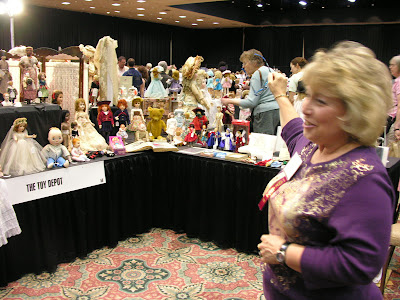
Cloth dolls in the image of African-Americans were the focus of attention for more than 1,000 enthusiasts at this year's convention of the UFDC in New Orleans. The earliest black doll displayed was sewn about 1850. Because cloth is fragile, most surviving black cloth dolls date from about 1870 — during Reconstruction. However, records indicate hundreds were sold at bazaars before the Civil War to raise money for the abolitionist newspaper, The Liberator, according to textile historian Roben Campbell. She says that the first sold for The Liberator in the early 1840s were made by an African-American woman who taught sewing to young black children in Salem, MA, where black and white women worked together in a women's anti-slavery society. As children, the author Louisa May Alcott and her sisters owned such a doll, most likely bought by their fervently abolitionist father, Bronson Alcott.
The story is that topsy-turvy dolls like the one above were made by black women working for white families, and which head was shown would depend on the race of any adults in the room, said Stamps, who is African-American. Campbell said that when she began work on the exhibit in 2005, she had to dig deep for information about black cloth dolls. Black cloth dolls from the 1870s to 1890s can bring from hundreds to thousands of dollars. Informative quilts, banners and five dolls shown in New Orleans came from the National Black Doll Museum, privately run by Debra Britt and her two sisters in Mansfield, Mass. (The Museum is on Facebook - click here to visit) The museum — one of two devoted to black dolls — owns about 5,000 and has 2,000 on display. The oldest dolls in her museum, Debra says, have no features at all and aren't easily recognized as dolls. They are wrap dolls handed down in her family and made by enslaved children, possibly in the early 18th century. Debra says They were made of gourds and vines, and wrapped with cloth and twigs. The children would fill those dolls with stones to carry the fear that they had and they would hide this doll from the master. Do visit the UFDC web site - if only for the free download of a lovely paper doll pattern.
Wednesday, 8 August 2012
London Hat Tricks
If you are planning a visit to London or are already there - look out for the hats! They are on a statue near you. The one above is on Nelson in Trafalgar Square and was made by Hand and Lock the famous embroiderers in London, who made Nelson's original bicorne. (Thanks to Philippa in Australia for pointing out the hat was made by Locke & Co - founded in 1675, the shop still exists today - do pay a visit!)
All the designs are by famous designers or milliners.
Not all are high up on podiums - some are at street level. Goodness what a fun place London is to be in at the moment!
Tuesday, 7 August 2012
Anna Meyer from the Darmstadt Madonna by Hans Holbein the Younger
Many years ago I came across this beautiful sketch of a young girl of wealthy family in one of my books. It is by Hans Holbein the Younger. Today, quite by accident while referencing something else - such is serendipity and life - I came across her, and the suggestive patterning of embroidered bands on her robe again. She is Anna Meyer daughter of a burgermeister of Basel. Here she sits with downturned eyes, in that diffident, rather slouched pose that adolescents seem the world over and throughout time to assume, aware only that much is being made of her hair, which seems to have a life independent of her. She is told it is her treasure and people remark on it and fuss on it all the time, not bothering themselves at all with the emotions and thoughts that curl and knot beneath it. Well, having found it again I could, this time with the instant google-tools we now have available, discover more about her.
The sketch was made for a painting which wasn't completed until some years later in 1526 when Anna had metamorphosed from adolescent to marriageable young woman. The gold of her hair is darkened with time and only a suggestion of its glory is now hinted at by the demure and appropriate tease of luxuriant plait on display between the thickly wrought bands encircling her head. Now she has the self-knowing look of womanhood. She has disciplined herself away from slouch to the fashionable sway back pose. perhaps as interesting for me and you is the transformation of those suggested embroidered bands on her robe.
Now we can see them in much more detail and, to some extent, link them with exemplar bands we have seen on early samplers. Below you can see the completed work, The Darmstadt Madonna, in entirety. Anna's dead mother is shown in covered up profile to the left of her stepmother. Her father and two little brothers, who were both dead at the time this portait was completed are seen on the left. All are posed on a fabulously detailed eastern carpet at the foot of the Madonna.
The sketch was made for a painting which wasn't completed until some years later in 1526 when Anna had metamorphosed from adolescent to marriageable young woman. The gold of her hair is darkened with time and only a suggestion of its glory is now hinted at by the demure and appropriate tease of luxuriant plait on display between the thickly wrought bands encircling her head. Now she has the self-knowing look of womanhood. She has disciplined herself away from slouch to the fashionable sway back pose. perhaps as interesting for me and you is the transformation of those suggested embroidered bands on her robe.
Now we can see them in much more detail and, to some extent, link them with exemplar bands we have seen on early samplers. Below you can see the completed work, The Darmstadt Madonna, in entirety. Anna's dead mother is shown in covered up profile to the left of her stepmother. Her father and two little brothers, who were both dead at the time this portait was completed are seen on the left. All are posed on a fabulously detailed eastern carpet at the foot of the Madonna.
Monday, 6 August 2012
Dolce & Gabbana Rock Berlin Work & Embroidery
Just in case you have spent up on the hols and don't have the spare thousand or two to accessorize your wardrobe - get your needle out now. Berlin work is THE fashion trend of the moment.
Get some low count linen and make a nice big bold statement with some berlin-work flower patterns.
You could make a simple tote with some scattered motifs - or just a small wallet for day or evening wear.
Of course, if you are really needle adverse - then find a woolwork cushion cover - old from a thrift or antique shop - or new (it will still be less than a thousand pounds I'm sure!) and reconstruct it into a simple bag. Failing all that - perhaps if you ask Father Christmas very nicely............
And just in case you think this is some localized D&G madness - here is a fabulous little frock by Valentino.... invest in needle and thread now!
Subscribe to:
Posts (Atom)


