Pages

Thursday, 15 December 2011

Sothebys New York Exhibition of Betty Ring Schoolgirl Embroideries Begins 14 January 2012 - Prior to Sale on 22 January 2012

Sothebys New York made an announcement today about the upcoming Betty Ring auction - I was hoping this heralded the on-line catalogue of the sale. But not yet - we have to be patient a little longer - however, do keep checking, click here for the link. Here is the announcement in full: Sotheby’s New York announces that it will offer schoolgirl embroidery from the collection of Betty Ring in a dedicated sale on 22 January 2012. Mrs. Ring is the foremost scholar and collector of American schoolgirl embroidery – superb needlework samplers, elegant pictorial embroideries and mourning pictures made in the earliest American cities and towns by the daughters of the prosperous ‘entrepreneurial’ elite. Important American Schoolgirl Embroideries: The Landmark Collection of Betty Ring consists of a comprehensive group of approximately 175 examples, assembled by Mrs. Ring starting in the 1960s, with pieces from all regions, periods and forms. The sale will be on exhibition in Sotheby’s York Avenue galleries during Americana Week in New York, beginning 14 January. The sale includes a rare and important needlework sampler by Mary Antrim dated 1807 (above), and belongs to an important, recently recognized group made by girls of Burlington County, New York (est. $80/120,000*); a rare and important needlework sampler by Matilda Filbert in Wolmesdorf, Pennsylvania dated 1830, and its composition is a naïve interpretation of an Edward Savage drawing (est. $50/75,000); a rare and important needlework sampler by Nabby Dexter dated 1785, and is the earliest-known example of the most enduring style from Mary Balch’s school (est. $30/40,000).
“Betty Ring was amongst the first serious scholars and collectors in our field who recognized the importance of American schoolgirl embroidery as a body of work,” commented Nancy Druckman, Head of Sotheby’s Folk Art department in New York. “Her numerous publications, exhibitions and lectures did much to increase the public’s awareness of this important and unique American art form. Betty’s collection, which we are honored to present at auction in January, is the fruit of her tireless and inspired research, as well as her connoisseur’s eye for beauty.”
From the late-17th through the mid-19th centuries, the rising merchant class in America had the financial resources, aspirations and determination to have their young daughters receive the best education – both in the standard subjects of the school curriculum, as well as mastering needle and thread. From Boston and New England, to Philadelphia, Washington, D.C. and the South, these girlhood embroideries have become treasured family heirlooms – vibrant and evocative examples of American decorative and folk art and, most especially, rare documents of women’s education in America. Through her studies of the young girls who made these remarkable pieces, as well as their teachers, Betty Ring was able to discern and document the distinctive regional styles in which they were created. Her personal collection is remarkably complete, comprising excellent examples across the art form. Mourning pictures in the collection – commemorative pieces that honored deceased heroes or loved ones – will be led by a rare and important embroidered and painted silk mourning picture: Sacred to the Memory of George Washington (second image above), which was likely done in Boston circa 1815 (est. $50/100,000). Elements from two Washington memorial prints may be recognized in the composition: Pater Patriae, engraved by Enoch G. Gridley after a now-lost painting by John Coles, Jr., and John James Barralet’s Apotheosis of Washington. In addition, the collection includes a rare and important embroidered and painted silk mourning picture by Betsey Clarke of Miss Patten’s School, Hartford, Connecticut, circa 1809 (est. $50/75,000).

Wednesday, 14 December 2011

Last Minute Lizzie!

Last Minute Lizzie was a name given to me by my mother as I was always dashing about filling my satchel for school. One day I was so pressed for time, running for the bus, that I didn't chase after my beret which blew away, fearing the chastisement of being late much more than the lines I would get from a prefect for being beretless. This was a beret with a name-tape dutifully sewn inside by my mother. And it was to my mother that the beret was returned by a policeman, saying he had found it in the middle of the road. If she had simply phoned school instead of every hospital, mortuary and crematorium in town, my homecoming would have produced considerably less hysteria.
But she was my mum and she cared and worried for us when we were too innocent to worry for ourselves and she worked late at night stitching us special gifts for Christmas. One year she gave me a gift resembling the one above which you can now buy from Boots and I was so thrilled. There began one strand at least of my long attachment to needle and thread. But I can't stop, I'm dashing around still, Last Minute Lizzie as ever looking for nice Christmas gifts. This is Boots Sew Sweet Sewing Set which sells at £8
This is also by Boots - what a delight for a young person to get them started on the true passion of stitching. Just click the images for more information.
Knitting needles and a ball of wool were gifts to us from mum when we were recovering from childhood ailments, those listless days of low fever when time passed so slowly - we were always so glad of these pick me ups. This is a Boots kit, prettily packaged for a young knitter and includes everything they need, including yarn, pre-cut felt pieces, and needle to make a little puppy.
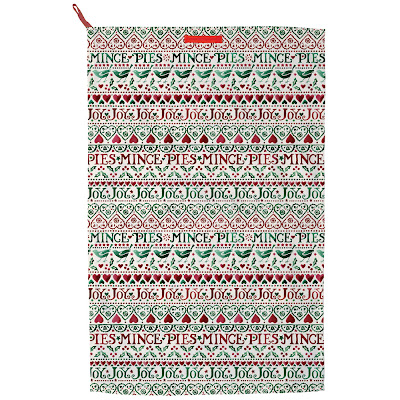
I am a great fan of Emma Bridgewater designs and her Sampler fabrics hit the spot for me.
Particularly this Christmas version which combines Joy and Mince Pies - how very true! Again click on the images for more information.
And here you see my Last Minute Lizzie Christmas Gift Making. Yes, I bought the plates and the joins, and the glass drill bits to go in the drill - and the ear defenders(you do need them as porcelain rings when drilled!)- and goggles and a dust mask. Twenty minutes. 20 minutes. This is the continuous time taken to drill one single hole through a standard plate. Not many people know that! I now have a deep regard for porcelain. But I must get along now - otherwise I shall truly be a Last Minute Lizzie again.

Tuesday, 13 December 2011

More Dutch Samplers On-Line For You To Enjoy

A wonderful site named geheugenvannederland has 36 sampler related images for you to enjoy - such as these posted here. The one above is a sampler from Enkhuizen (another of my favourite places in the Universe) dated 1795.
Above is an earlier example of 1788, also from Enkhuizen - both samplers are in the Zuiderzeemuseum.
This sampler is from Amsterdam and is dated 1801 - it is in the Nederlands Gevangenismuseum. To visit these samplers for yourself, just click here. You can click on any image for more details and if you click on the button labelled Opslaan to the right of the larger image and choose the option to open, you can enjoy a larger image.

Monday, 12 December 2011

Fabric of a New Nation: American Needlework and Textiles, 1776–1840 * Art Institute of Chicago * 16 December 2011 - 13 May 2012

To quote from the Art Institute of Chicago: This bedcover - a nine patch quilt of 1800/20 from New England or Mid-Atlantic USA (A gift of Donald Young and Shirley Weese Young)is one of the items in this exciting exhibition which features over 45 bedcovers, coverlets, needlework, printed handkerchiefs, and other household textiles from the permanent collection of the Department of Textiles, explores the evolution of an American textile tradition as home creation, cottage industry, and commercial production developed between the years 1776 and 1840. While some needlework and textiles during this period were born out of necessity, others evoke refinement and sophistication, reflecting the overall growth, ingenuity, and prosperity of a new nation. Traditionally textiles, whether made in the home or commercially, were considered prized possessions, but their value was not merely monetary; they often held special significance for the makers and their descendants. Many such textiles bear the maker’s name, and as treasured heirlooms were passed from one generation to the next serving as family record. The sewing of textiles was also vital to the maintenance of a household. This important female skill not only provided the necessities of clothing and bedding but also a socially acceptable activity for women. The sewn and embroidered textiles in this exhibition represent the work of schoolgirls and women who had the means and time to pursue the needle arts. The works’ highly skilled execution and complex designs are evidence of the artistic and personal expression they provided. A bridge from home to commercial production can be seen in the exhibition’s woven coverlets. Coverlet weavers in homes and separate workshops formed a cottage industry that would eventually grow into a full-scale commercial business by the mid-19th century. Printed textiles, on the other hand, were a product of the innovations and technological advancements of the Industrial Revolution, part of the commercial manufacturing industry that disseminated affordable textiles to a wider audience. With the mechanization of production and printing, textiles were able to keep pace with fashion and current events. Whether sewn, woven, or printed, the textiles in this exhibition trace the development of an American textile tradition—one in which industrialization played a dominant role transforming raw materials into finished products but one that was also impacted by changes in the American home from creation out of necessity to a burgeoning consumer economy. Within these diverse textiles and their development, one can witness the innovation and progress of an early but thriving new United States. For more information about this exhibition, just click here.